Touch Around The Earth

The adventures of a massage therapist as she explores touch around the earth. From Chicago to Thailand, Nepal, India and Japan, she will be receiving massage, studying massage, studying and practicing yoga and meditation, and learning about how people around the earth stay healthy and happy.
Showing posts with label meditation. Show all posts

Sunday, April 18, 2010

namaste


(written April 20, 2010) A little over a week ago, I left the polluted air of Kathmandu and took a tourist bus to the smaller town of Pokhara which is a gateway to the Himalayas. The bus was a few hours delayed because of a break down and a small roadblock protest due to electricity outages (almost an every day occurrence here). I had heard that there was a women's empowerment program there that employed women to guide and support the treks into the Himalayas. I had a limited time to do my trek, and I didn't want to do it on my own, so I went to the Three Sisters Adventure Trekking and hired a guide. I thought it was a great idea to support a woman, especially because I've heard that sex trafficking and prostitution is still common in Nepal when women can't make a good living in other fields.

When a short Nepali girl named Muna greeted me with a warm smile, I had a feeling I was in for a treat. She had a soft, sweet voice, and though her English was broken, I could tell she had a good heart. So we packed up and headed up into the mountains for a week-long trek. As much as I wanted to get up past the tree line, and close to those beautiful peaks, I decided to take it easy as I didn't have enough time to get there with a moderate pace, plus, I heard about villages, hot springs, waterfalls, beautiful views and rhododendron forests. There was no need for a tent, a stove, or even a sleeping bag because we would be staying at friendly lodges and tea houses along the way. It was quite warm the first couple days, so I wasn't shy about jumping into the river to cool off once in a while. The area was full of rice fields, waterfalls, cornfields, orchids, butterflies, and beautiful Nepalese people who greeted me with "Namaste!" and usually a smile. It wasn't until the middle of the second day that we got a glimpse of the legendary peaks.

When I wasn't completely out of breath from climbing up the steep stone stairs and trails, I got to talk with Muna about her life. She grew up in a small mountain town, a few hours from the trek around the Annapurna Circuit. Her father died when she was only seven, and she is the oldest of three kids. Women are not allowed to re-marry in Nepal, so Muna's mother continued her farming work and raised her children with love and faith. Muna only went to school through the eight grade, when she came home and started working to support her family. She wanted to make more money for her family, so when she was 20, she was accepted into a scholarship program at Three Sisters, where they taught her English, ecology, trekking, and climbing. She had to start as a porter, carrying sometimes up to 50kg of tourist's gear on her back. She had some amazing stories, of getting stuck in hail storms, getting lost, and having to sleep in the dining halls of crowded lodges. But she is learning more English and hopes to become a full fledged guide, leading groups on treks into the mountains.

The trail followed a beautiful river valley, up into the hills and through beautiful woods and little villages. The morning we were in Ghorepani, we woke up at 4am for a heart-pounding hike up to Poon hill (10,561 feet, 3,219 meters) in the cold, in order to watch the sun rise over the Annapurna and Dauliguri mountains. It was a spectacular sight, watching the light hit those gorgeous snow-capped mountains, and the camera shutters were going off like crazy! Every night, we would stay at a simple lodge where we would have a hot shower and a warm dinner (very luxurious for trekking!) And we would be up early the next morning to get some miles in before it got really hot. I loved being up in these villages, which were far away from roads and cars. Anything that the villagers or trekkers needed that couldn't be grown on the terraced fields was carried to the villages by mules and people carrying heavy loads with a strap on their head. My neck ached every time one of them walked by me (usually carrying twice more than I was, and walking twice as fast as me!) Muna was wonderful company, and we grew quite close through the week. One day, we decided to take it easy and enjoy a day resting and going to a hot spring. I was able to give her a massage and was thrilled when she was snoring away. I could feel the tension from carrying all the weight all those years, as well as the weight of the responsibility of taking care of her family, and was glad I could do a little something in return for all the support she was giving me. In Chomrong, I had a massage from a local Tibetan man who was offering massages to the trekkers because I was having some pain in my foot and ankle. My “flat-lander” legs were pretty tender from covering all those mountain miles, and it was a good learning experience of what NOT to do when someone is so tender. But I still appreciated being able to receive a massage while out on a trek! And later that night, the locals were celebrating their New Year with dancing and singing and drumming! It was so beautiful... and fun to watch the porters dance their hearts out despite the heavy loads they had carried that day.

I was hoping to go to a meditation course while I was traveling, but my time was running out, and I wanted to see more of the country and experience the culture. So, I brought along a book about walking meditation by Tich Nhat Hanh and practiced the techniques as I was hiking along. It was a good challenge to watch my breath, especially as the stone steps got steeper, and the sun got more intense. I could observe the thoughts in my mind that were saying “this is ridiculous… I am so hot and tired… I can’t wait for the next shady spot!” and I would return my awareness to my breathing and do my best to enjoy the present moment. I also noticed when my mind was saying “I love this view… I am going to miss this when I am back in the big city” and realize that I wasn’t fully in the present. I would bring my awareness to each step I was taking, and visualize a lotus flower blossoming under each step I took, planting seeds of joy and happiness. I also liked Tich Nhat Hahn’s idea of focusing on gratitude, and would say to myself “yes, yes, yes” (with my inhale) and “thanks, thanks, thanks” with my exhale. Or, if I was hiking up a steep part and my breath was as short as my step, I would say “yes, thanks, yes, thanks.” And once in a while, I would get a flash of one of the disfigured people I saw in India and a wave of gratitude would wash over me.


After trekking my week of trekking, I returned to the town of Pokhara, where I connected with a 26 year old Tibetan woman named Tsering who a friend in Chicago had connected me with. In 1959, her grandparents fled their homeland in Togpa, Tibet and walked for two weeks with their two young children in order to flee their home in Tibet with hopes of a better life in Nepal. They live in a refugee camp just outside of town, where Tibetan people live in a community, trying to carry on their traditional ways of living, far from their homeland. The Nepalese government still doesn’t issue residence cards for them, or even their children who were born in Nepal. So, they can’t get official jobs, and they are continually denied the opportunity to leave the country. Tsering is a single mother, and her parents both have serious health problems, and the only way their family makes money is by selling souvenirs to tourists. So she spoke to me of her dream to come to America, where she can hopefully make more money and take care of her parents and give her son a better life. She thinks of this dream many times everyday, and it stresses her out that she is not able to go. In fact, she is not able to leave her country except to go to India for a spiritual pilgrimage. This made me feel extremely grateful for the freedom that I have to travel, and work almost anywhere. I tried to tell her that it is not always so easy to make good money in America, even for American citizens, and pointed out to her how beautiful her life is in Nepal, with her parents close by, and the beautiful temples and natural wonders that she can visit easily, and the amount of time she can spend with her son. I gave her her first massage, and she loved it, and had many questions. She is interested in learning massage therapy, and I am considering returning to Nepal to teach a group of Tibetans massage so that they have another way to make money. Of course I envy her life a bit, because she gets to live near the most beautiful mountains in the world, and has a beautiful son, and a supportive community. But, the grass is always greener, and I am doing my best to be grateful for every moment, wherever my feet are landing.

Namaste

Wednesday, March 31, 2010

peaks


I woke up on the airplane feeling a bit fuzzy and as my eyes started to wake up, I noticed some strange clouds off in the distance. And then my heart started pounding as I realized that I was looking at the Himalayan Mountains! I have been dreaming of seeing these mountains for many years, drooling over friends photos from treks and adventures they had in these ancient mountains, and I could hardly believe I was seeing them! I was on my way to Sikkim, a tiny north-eastern province that is bordered by Bhutan, Tibet(now China) and Nepal. The four hour bumpy ride up to the capital city of Gangtok included views prayer flags, and surprisingly large villages that have settled along the river. It was a hot ride, and I was pretty exhausted from an overnight bus ride the previous night on a dilapidated bus that went from Rishikesh to Delhi and passed through some amazingly stinky areas that woke me up from sleep! As you can imagine, I fully appreciated the delicious home-cooked food and the hot bucket of water that awaited me when I arrived at the ashram where four of my Chicago friends have taken up residence. The next week was a beautiful, healing experience, and difficult for me to describe in words, but I will do my best:


I arrived on the eve of the spring equinox, and there was much excitement and preparation going on for a spring celebration that included making offerings and blessings to the goddess. Each morning I would jump out of bed and peak out the window to see if the white fluffy fog had lifted so that I could get a glimpse of the peaks, only to find a sky that was 90-100% white, and I only a few layers of peaks. But even that small amount of topography brings me peace. There is something about seeing the three dimensionality of the earth that gives me a sense of space and reminds me that there is something much much larger and expansive than my small experience of life. Towards the end of my stay in Sikkim, I started to feel a bit sad, even though I thoroughly enjoyed the thunderstorms and rainstorms (even after getting almost totally soaked after visiting an orchid show). And when I reflected on this sadness, I felt like it could be a metaphor for my inner atmosphere. Sometimes when I check in with my clients when they come to me for bodywork, I ask them how their inner atmosphere is, or maybe I am asking for an emotional weather report. And I was feeling a bit cloudy, especially surrounded by these people who were so dedicated to their spiritual practices. But throughout the week, as the ceremonies progressed, I started to feel more in touch with my inner divine nature, and realized that the sun is always shining brightly in my deep inner self, and all of my peaks and valleys can be viewed with clarity. The "clouds" that come in my life can be observed in my meditation practice, and if I can manage to stay neutral and not react to them, I can experience more peace and an expansive view of life where everything is accepted. I was grateful for the vision of the peaks that I had on the airplane, and kept them in my heart as I explored the area outside of Gangtok, enjoying the more subtle things like the waterfalls and the beautiful green foliage, as well as the smoothness of the skin of the children, and the wrinkles on the elders faces. Sikkim is a beautiful melting pot of people from the surrounding countries and cultures, and it was inspiring to see Buddhists, Christians, Hindus and Muslims living in the same area in peace.

As far as touch goes, this area did not have many opportunities to receive touch, so I ended up sharing touch with the people in the sangha (spiritual community) and I was glad that I had something to offer in return for all the amazing nourishment I was receiving, both nutritionally and spiritually (plus, it was a great atmosphere to practice my new Thai massage skills!). It seems like sitting in the meditation posture for a really long time can cause some significant physical challenges. And, as some of them shared with me, when they are cleansing and purifying their energy body, physical discomfort can surface. I was inspired by their strength to continue their personal practices, and by their faith that the practices their guru was giving them was the best thing for their growth. It was very interesting for me to observe the relationship between a guru and disciple. This relationship is not very well understood by those of us in the west. Guru can be defined as "one who is regarded as having great knowledge, wisdom and authority in a certain area, and who uses it to guide others (teacher). In Sanskrit, gu means darkness & ru means light. As a principle for the development of consciousness it leads from the darkness of ignorance to the light of knowledge." This person can be living presently, or long ago left his or her physical form (Jesus can be seen as a guru for many people!) I heard someone say that if you ever meet god and your guru after dying, you will bow to your guru before god, because you would not have such a close relationship to god without your guru's guidance. But it takes an immense amount of faith, trust and surrender to create this relationship, and I witnessed so much love and dedication going in both directions in this relationship at this ashram. I was relieved to see this because I have felt quite sensitive about gurus after one of my friends died in a horrible accident involving a sweat lodge that was lead by a man who acted like a guru (James Arthur Ray). I personally feel that a guru should help his or her followers become more in touch with their own inner truth and wisdom, and that the guru should continuously keep their own ego and intentions in check, so that they don't harm the people who have put their faith in their hands. And as I rode down the bumpy road back down from the mountains one week later, I felt assured that my friends are in good hands, inspired by their dedication, and more in touch with my personal "inner guru".

I also learned a lot about Indian culture, staying in this ashram. One thing I find interesting is that they see no need to say thank you or please. One person explained to me that because we are all connected, one person's happiness effects the other. So a smile is all that is needed. I found this so difficult to not say thank you, with the generous servings of rice bryani, dal, sag paneer, and sweets that were being heaped onto my plate! I also was amazed at the generosity that Baba had in spending time with me, despite all of his other disciples needs.

Have you ever tried eating sloppy food with your fingers? It is difficult to do at first, but when I looked around the table and realized I was the only one using a fork, I gave it a try and got to really enjoy it! Even when I was eating rice and soupy dal, I got to feel the texture with my finger, and stir it up to the consistency that I liked, and eat it right off my fingers. There is something really intimate about this. I found that I ate slower, enjoyed my food more, and digested my food very well!

Another aspect of Indian culture that I have a deeper understanding of is the way that women are treated and perceived. My friends have adapted the Indian dressing style which is very modest, baggy over the hips, and usually with a scarf draped over the chest area, and never exposing shoulders or cleavage. My understanding of the intention is to keep unwanted attention coming in from men. So I am attempting to dress more modestly, and though I do get stared at, I don't have many problems with Indian men. And if I do, I school them the way their mother would, with a fierce look and a strong "No!" Mostly, they are just curious... one guy I met had only talked to one other foreigner before. Difficult for a Chicago girl to imagine... I grew up in the melting pot of Logan Square, Chicago with Puerto Rican, Mexican, Polish, and Yugoslavian neighbors!

Hope the sun is shining in your inner atmosphere today!

Sunday, March 14, 2010

Ganga


What an incredible two weeks it has been on the holy Ganges river in India, otherwise known as Mother Ganga...

The International Yoga Festival was an incredible week filled with amazing workshops on yoga asana, meditation, yoga philosophy, chanting, and more! Many of the people who were speaking to us were saints, and swamis, and there was always a warm welcome for them at the ashram, including people lining up, blowing a special horn, and standing up when they came onto the stage. They spoke to us about the importance of understanding yoga as being so much more than the poses that are done in a typical yoga class. There was much talk about the importance of evolving so that your spiritual practice flows into every part of your life. Concentrate on the inner world, on consciousness, which is beyond death, which is God/Spirit.

"the ocean needs the drop just as much as the drop needs the ocean... and every drop is potential divine." - Swami Divyanand Teerthji

So we are to try to evolve beyond our fear of death, which is present from birth. I got to experience a bit of this fear when I survived my first close encounter with some kind of parasite. I believe it was from drinking the filtered water at the ashram... which is not quite filtered enough for my western belly! Though I didn't feel like I was dying, two days of the runs and a high fever and body aches, and not enough energy to attend even the lectures forced me to ask my lovely Indian roommates to go pick up some medicine for me. This was the first pharmaceutical I have taken in over 11 years! But I am grateful that is seemed to have taken care of it. The doctor who I saw has a charitable hospital that runs completely on donations! I was so amazed to find the billing department which consisted of a statue of Ganesh (the elephant god), and a donation box! The doctor refered me to an ayurvedic clinic where I received massage for three days. My therapists were lovely, though one of them had rough hands, probably because her life has not always been so easy, and she has had to do farming or maybe even construction to make a living before this. One day, I had both therapists massage me in unison - an Ayurvedic massage technique called abhyanga. This vigourous, oily massage left me feeling relaxed and invigorated. There were a few differences I noticed between this massage and Swedish massage:

1 - Lots of oil - even on the scalp and hair.
2 - Little to no draping, and massage covered even my chest area.
3 - The oil had special herbs in it.
4 - The doctor came in to supervise and make sure they were doing a good job.


Today is one of the holiest days of the festival of the Kumbha Mela, the largest religious gathering in the world. It happens only once every twelve years, when Sun is in the zodiac sign of Aries, and Jupiter enters Aquarius. During this time, it is believed that the holy river attains properties of nectar from the gods during these times. Millions of people come to bathe in the river during this time, with the hopes that a dip in the frigid waters during this time will spare the bather from the cycle of life and death. Though most of the action is happening in Haridwar, the holy city 20 km south of where I am staying, there are still thousands of colorful pilgrims walking through the streets, bathing in the river, and visiting temples along the way.

Haridwar is so full of people now, that there are rows and rows of tents everywhere you look! The camps are centered around various famous spiritual teachers from all over India, and many of them have huge banners advertising them. I visited one teacher named "Pilot Baba" and he had quite the settlement, including fountains and statues and tents for eating, for pujas, and meditation. I think this is India's equivilant of the burning man festival, only it has more of a spiritual focus. My favorite part about being in Haridwar was seeing the rows and rows of holy men )(sadhus) dressed in orange, or simply wearing a loin cloth. Upon my arrival to Haridwar, my friend Elaine and I were greeted a dancing, chanting saddhu who had greens and flowers balanced on his head, and a collection of flower garlands around his neck. He promptly danced up to us and blessed us with a small ceramic statue, and then placed a garland over both of our heads. He brought me the gift of laughter, and I felt joyful and clear!

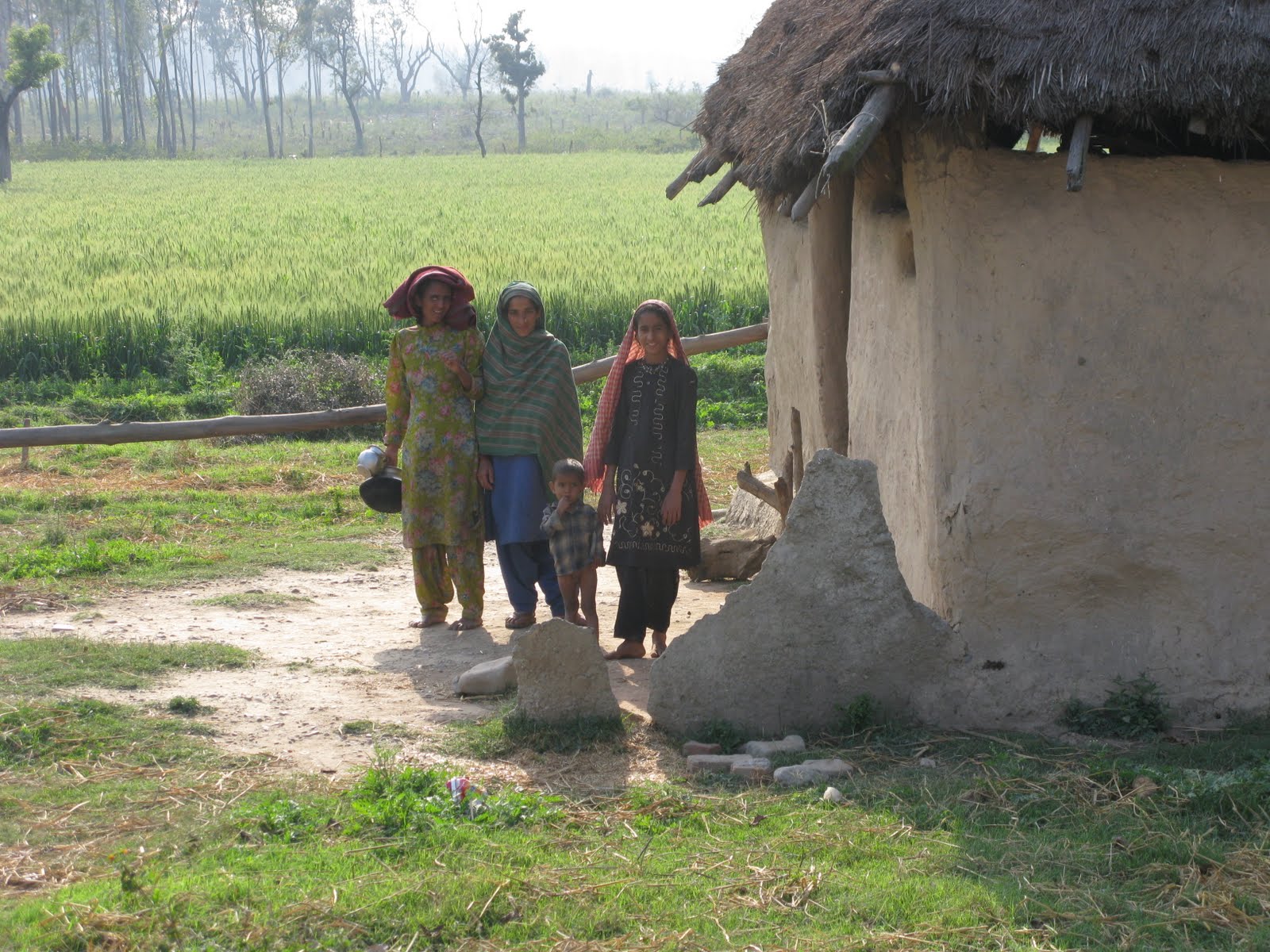
I ventured out of Haridwar with my new friend Elaine to go find the International Rainbow Gathering that was starting to gather near an ashram outside of Haridwar. The bus driver wasn't exactly sure where the ashram was, and was stopping to ask directions, and dropped us off a bit farther away than we would have hoped. But it ended up being a beautiful walk trough wheat fields and simple adobe - like homes. People came out of their homes to see the strange pale-faced women walking through their village with backpacks on their backs. They seemed like happy people, though they didn't smile for the camera when I pulled it out. I really got a feel for the simple life that they were living, and longed to be invited into their home for a cup of tea. But it was getting late and we wanted to set up camp before night, so we kept on hiking. The gathering was a small group of people from all over the world, and we were welcomed with a cup of hot chai that included fresh cows milk from the villagers. We set up camp and headed down to the main circle area which was right on the bank of the ganges, for a delicious vegetarian meal that included a prayer song, and passing around the magic hat for donations that go towards feeding everyone who comes to the gathering. It was good to be reminded of the miracle of Rainbow, that there is always enough food when everyone is sharing energy. I decided not to stay long at the gathering because I wanted to experience more of India... though it was wonderful to camp out under the stars and wake up to the beauty of the fog lifting off of the river Ganga.

My new friend Michael and I had a wonderful visit in Haridwar with my friend Marcie who I know from the Breema Center in California. She has made India her home now, and enjoys the freedom of being able to live a simple life, and have more time to do her spiritual practice, and not have to work as much as she did in the states. She showed us her favorite little streets, and some beautiful architectural sights, as well as some special temples where we were the only foreigners present. In the evening, we attended the arati, on the banks of the river, where I was grateful I had the experience of growing up in a big city because the crowds were huge! There were people bathing, sending flowers down the river, and praying and singing... and the police were there to keep the crowd moving, and it was amazing how it all flowed, in an organized, chaotic way! I was glad I had a friend's hand to hold as it would have been easy to get separated in that crowd. And on the walk back to the taxi, we had many people coming up to us, wishing to shake our hands and practice their English, asking us where we were from, and requesting that we stop for a cup of tea. We politely declined, and took a taxi back to the quieter town of Rishikesh.

Just as it is challenging for the Indian people not to stare at the blonde foreigners, my western eyes also are feasting on all of these spectacles that I would never see back home. Hinduism seems very exotic and strange to me, though I can definitely relate to their love of nature. I can't help but wonder what the earth would be like if people loved their rivers as much as the local people here do. They shower her with flowers and incense and send her love with the arati celebration every night, where they use fire to bless her, as well as all the people who are there. One temple I visted had a beautiful banyan tree whose roots were covered with red strings that people tied onto it with their prayers. There were so many strings tied onto it that it resembled dreadlocks! The locals would walk up to the root, and say a prayer and then push the root as you would a child in a swing, ever so gently. Of course I had to take a turn at this, and really enjoyed how it connected me to my virtual roots.

You would think that their worship of nature would make Indians very ecologlically minded, however there is so much litter everywhere, and I hear that they use tons of pesticides on their fruits and vegetables. But there is a strong movement in this state, to start using organic farming practices, and make the whole state organic! One thing this area has going for it is it is almost completely vegetarian! Non-vegetarian foods are banned in both Haridwar and Rishikesh, which is really great for the environment because it takes so much more energy to produce meat compared to vegetables. As I have been vegetarian since the age of fourteen, I feel right at home here! Another thing that is banned from these holy cities is alcohol, which I haven't missed much, as there are so many ways to get high naturally, from the yoga, meditation, and natural beauty that is everywhere!

Tuesday, February 2, 2010

listening


A week ago Monday morning, in the old walled city of Chiang Mai, I met up with a group of people from all over the world to go to the market to buy flowers, incense, candles and fruit for an offering to Buddha, God, and to the lineage of teachers of Thai massage. Known as "Nuad bo Rarn" here, Thai Massage is an ancient healing practice that uses "sacred medicine". It was brought here from India through China along with the teachings of the Buddha. There was a hermit, known today as Dr Shivago, who offered bodywork and healing to the Buddha and his sangha to keep them healthy in body and mind as they traveled and shared their teachings. This practice was passed down from generation to generation in the temples, and in families.

We drove 20 minutes outside of Chiang Mai to meet Pichest Boonthume, who is one of the more traditional Thai massage teachers in Thailand, and is truly a master. His teachings are deeper than I had expected them to be. I was interested in studying with Pichest because I had heard that he has found ways to use his body intelligently and not injure himself. I also knew that he did very deep physical work, but I had no idea his teachings were so deep emotionally and spiritually.

We begin the day in a relaxed way, people filtering into the classroom, which is a large room, with about 1/4 of the space used as a temple to the Buddha, teachers and our parents, and spirits. There are mats placed around the room, and pillows, and not one single chair. Pichest gives talks about meditation and dharma, and the importance of taking good care of ourselves so that we can give good feelings to people when we are giving massages. He shows us ways to get deep pressure without using too much energy or force, and even shows us ways for us to receive benefits (this reminds me of the principle of "Mutual Support" I have learned from Breema Bodywork. We spend some time praying and chanting to the buddha, and to the lineage of teachers, as well as spirit. The rest of the day is spent watching him give amazing effective treatments, and laughing (he really loves to make us laugh), and watching how he assesses the body with his heart, not his mind. We then take turns working on each other, and practicing listening and maybe some of the new techniques he demonstrated (but only if they are a good fit for the person we are working with).

My sessions with him have been quite intense and profound. He is incredibly intuitive and could see where I was holding on to emotions and things from my past, and used some ancient chants and folk medicine to help me to let go of this old energy. I felt incredibly light and free after this... like I had been carrying an invisible backpack, and it was suddenly gone. The next time, he was working very deeply on my neck and I burst into tears, but not because of the pain, but because an emotional block was being released.

I am beginning to understand the power of the heart, and the importance of taking time to sit with myself and listen. Listen to the emotions and thoughts, and watch them pass. He says that when you have a thought, it's like a big rock that is tossed into a still pond, and we usually follow the ripples which can be big and dramatic. But if we simply follow the rock, it simply falls to the bottom of the pond.

I resonate very deeply with his teachings, and feel that my intentions are very similar to his when I work. I can't tell you how often he says "listening" and "from the heart". And the name of my practice is Listening Touch and my logo is hands in the shape of a heart, with a ripple. So now, I will practice deepening in with my heart, and aim to not follow the ripples, both in my meditation, and in my bodywork.

Today was another amazing day. Pichest guided me to make a special offering and I received a blessing from a American Buddhist nun who only comes to see Pichest once per year. When she gave me blessings from the ancient mother goddess, I felt an old, negative thought pattern slip away. As I sat, listening, I could feel deep peace and unconditional love settle into my being, and it was sealed with gold leaf on my heart.

Wow... I am so grateful... and sending you a little virtual blessing of gold on your heart!